
Palestine has a long and vast history. First documented in ancient Egyptian tablets as Peleset over 3000 years ago, the region between the Mediterranean and the river Jordan has come to mean many different things to many different peoples. Throughout the ages, Palestine has been home to dozens of cultures, kingdoms and empires.
It is important to stress that when we talk about Palestine, we are not talking about a Palestinian nation state. For the vast majority of history, the concept of a nation state did not exist. Today the nation state is so ubiquitous that it may feel natural. The impulse to imagine our ancestors as some closed-off, well-defined, unchanging homogeneous group having exclusive ownership over a territory that corresponds to modern day borders has no basis in history and is the foundational myth of many ethno-nationalist ideologies.
The current situation in Palestine has its origins in the the first Zionist congress convened in the Swiss city of Basel in 1897. Zionism is a settler-colonial political movement that called for establishing a Jewish nation-state in Palestine with a Jewish majority. The issue here, of course, was that Palestine was already inhabited. The question of what to do with the native Palestinian Arabs animated much of the early discussions of the Zionist movement. After world war I, Palestine fell under the control of the British empire, which was sympathetic to the Zionist movement and promised “a national home for the Jewish people” in Palestine (Balfour Declaration). The British saw in the Zionist movement a mechanism through which British interests in the Levant and Suez could be realized.
Emboldened by the Balfour Declaration and supportive British governors, the Zionist movement ramped up its colonization efforts while harshly repressing any Palestinian movement or organization. This enabled the conquest and mass destruction of hundreds of Palestinian villages and neighborhoods, ultimately leading to the Nakhba in 1948 – the establishment of Israel through the ethnic cleansing of Palestinians and the erasure of their society. By the end of the war, 800,000 Palestinians would be ethnically cleansed from approximately 530 villages and communities. To this day, these 800,000 and their descendants are scattered all over the world, and Israel refuses their right to return home.
The remaining Palestinians would live under martial law for decades to come, and have their communities turned into segregated, heavily controlled enclaves surrounded by barbed wire. These early years would prove formative to the discriminatory regime of laws (also known as Apartheid) that govern Israel to this very day.
The story since 1948 is one of further expansion of the Zionist colony, apartheid and almost constant violence against Palestinians. This is supported diplomatically, financially and militarily in large part by European and most recently, American governments, who see the colony as their own stronghold in West Asia. The colony’s atrocities are also masked by millions spent on propaganda campaigns in the west, known as Hasbara, often portraying it as a progressive, democratic and pluralistic nation, friendly to artists, queer folks, women and young technocrats.
However, the story also involves Palestinian resistance, coming from within the occupied territories in Gaza and the West bank – including the 2 major intifadas and other massive protests, civil disobedience actions, boycotts and other forms of resistance. The Gaza strip itself has been under siege since 2007, it has been described as “an open air prison”. It has faced brutal assaults under various Israeli pretexts, such as the 2008 and 2014 wars which killed thousands of Palestinians, including hundreds of children. This has made Gaza a convenient testing ground for Israeli arms manufacturers, who tout their equipment as “battle tested”.
Another example of resistance, the Boycott, Disinvestment and Sanctions (BDS) movement is a non-violent human rights campaign formed in 2005 by over 170 Palestinian non-governmental organizations, unions and civil society groups. The aim of the movement is to campaign for and protect the rights of Palestinians through the application of international pressure on Israel until it complies with international law.
This is the brief context for the events on October 7, 2023 (also known as Al-Aqsa flood). Please see the resources below for further information on the history, current situation, Canada’s role, Palestinian writings and more.
In Saint John
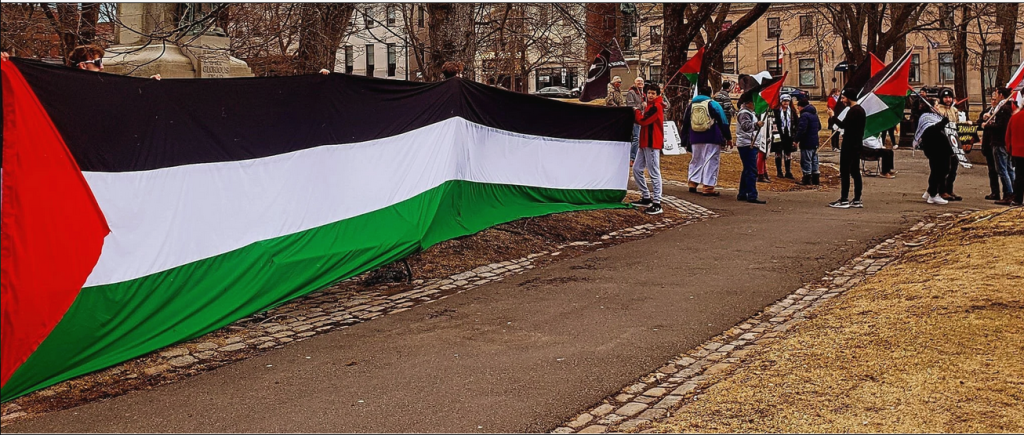
Founded in 2018 in SJ, the Palestine Solidarity Committee of Saint John (PSC-SJ) is a grassroots solidarity and advocacy group committed to standing with the Palestinian people in their struggle for freedom, justice, and self-determination.
It is a community of people from different backgrounds brought together by a shared belief that the ongoing occupation of Palestinian land, the denial of basic human rights, and the system of discrimination imposed on Palestinians cannot be ignored or accepted.
PSC-SJ works to raise awareness in the community about the realities facing Palestinians and to build meaningful solidarity through education, advocacy, cultural events, public actions, and community engagement. It challenges misinformation and harmful narratives that have long shaped public understanding of Palestine, while amplifying Palestinian voices, history, culture, and lived experiences.
As a grassroots movement, PSC-SJ believes in the power of people coming together to speak out against injustice and to support the Palestinian struggle for liberation, equality, dignity, and the right to live freely on their land.
Another group – The Atlantic Canada Palestinian Society of Saint John (ACPS.SJ) is a grassroots, volunteer-led organization committed to promoting Palestinian culture, heritage, and community engagement in SJ and the surrounding region. Through cultural programming, public education, and inclusive events, we aim to build understanding, foster solidarity, and create meaningful connections between communities across Atlantic Canada.
Resources
- Palestine 101
- Independent Jewish Voices
- Labour for Palestine
- Boycott, divestment and sanctions movement
- Arms embargo campaign in Canada
- Amnesty international’s report (2024) on the genocide in Gaza
- U.N. report (2025) on the situation in Palestine
- Current statistics and analysis
- Books – The hundred years’ war on Palestine by Rashid Khalidi, Palestine by Joe Sacco, anything by Ghassan Kanafani, feminist readings